
How to Fix a Broken Hollandaise Sauce
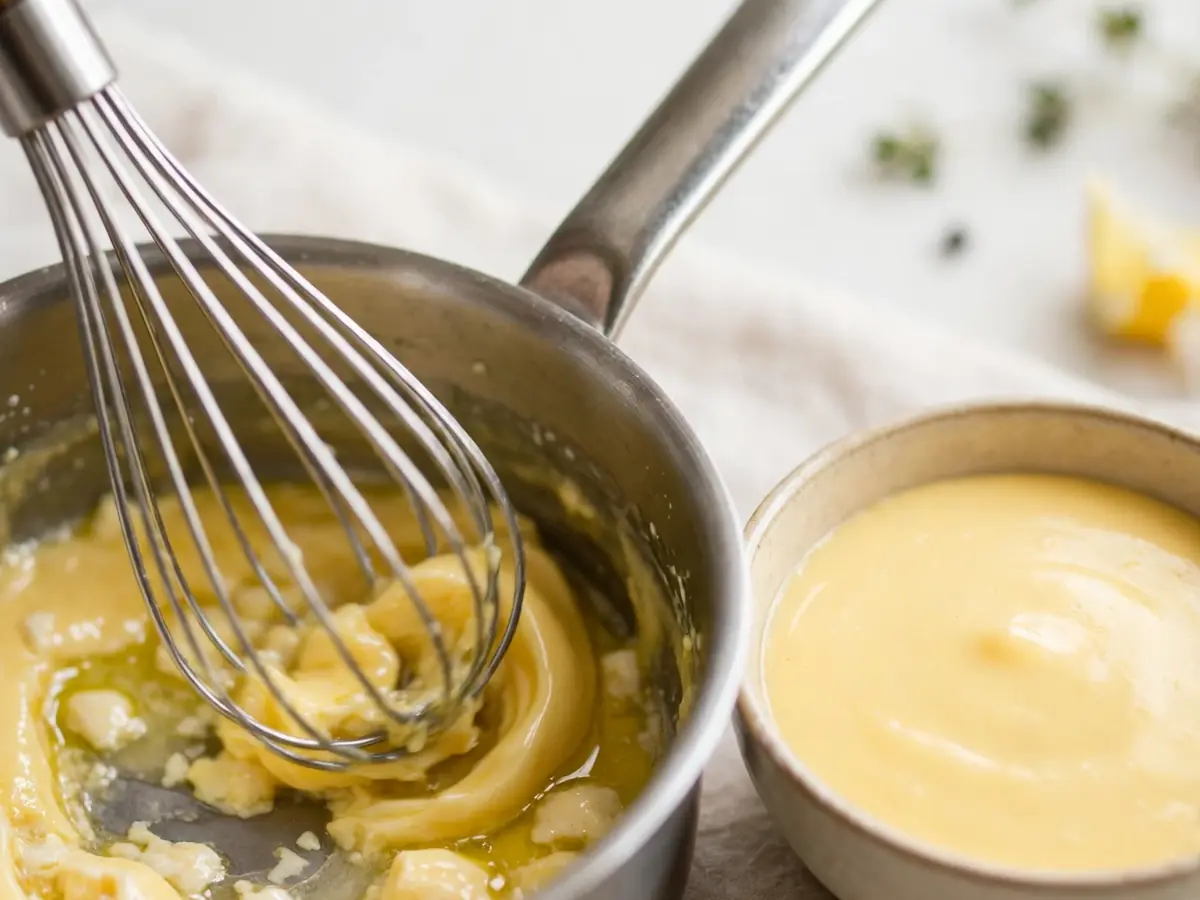
Hollandaise is one of the most rewarding sauces a home cook can make, and also one of the most fragile. One moment you have a glossy, pale-gold emulsion clinging beautifully to a spoon; the next, the sauce looks grainy, dull, and separated, with butter pooling at the edges. The good news: in almost every case, a broken hollandaise is not ruined. It is simply out of balance, and it can be brought back with a little patience and the right technique.
This guide covers why hollandaise breaks, the three most reliable repair methods (each with exact quantities and timings), how to rescue a sauce that has gone too hot or too cold, what to do if it tastes flat or metallic, and how to store and reheat leftovers safely. Every fix below works on a standard batch made from 3 egg yolks and 170 g (12 tbsp) of butter, which yields about 250 ml (1 cup) of sauce and serves 4.
Why Hollandaise Breaks in the First Place
Hollandaise is an emulsion: tiny droplets of melted butter suspended in a mixture of egg yolk and water. Egg yolk contains lecithin, a natural emulsifier that coats the butter droplets and keeps them from merging back together. The emulsion holds only within a narrow temperature window, roughly 60–68°C (140–155°F).
Three things push it past its limits:
- Too much heat. Above about 70°C (158°F), the yolk proteins coagulate and squeeze out the fat. This is the most common cause, especially when butter is added too quickly or the bowl sits over aggressively simmering water.
- Butter added too fast or too cold. The yolk base can only absorb butter gradually. Dumping in a cold chunk shocks the emulsion and drops the temperature below the working range.
- Too little water in the base. The yolk-and-water phase needs enough liquid to form the continuous phase of the emulsion. If the base reduces too far before the butter goes in, the sauce has nothing to suspend the fat in.
Knowing which of these happened helps you choose the right fix, but in practice the rescue methods below work regardless of cause.
Before You Start: Equipment and the Standard Batch
Have these ready before you attempt any repair:
- 1 clean medium bowl (glass or stainless steel)
- 1 small saucepan that the bowl can sit over without touching the water
- A balloon whisk
- 1 tablespoon (15 ml) cold water
- 1 fresh egg yolk (for the fresh-yolk method)
- 1 tablespoon (15 ml) lemon juice or white wine vinegar
Standard batch reference: 3 egg yolks, 1 tbsp (15 ml) water, 170 g (12 tbsp) unsalted butter melted and warm (about 50–55°C / 122–131°F), 1 tbsp (15 ml) lemon juice, ½ tsp (3 g) fine salt, a pinch of cayenne. Serves 4 as a sauce for eggs Benedict, asparagus, or fish.
Method 1: The Fresh-Yolk Rescue (Most Reliable)
This is the fix to reach for first. A fresh yolk provides new lecithin and new liquid, giving the broken sauce something to re-emulsify around.
Ingredients and equipment: 1 fresh egg yolk, 1 tbsp (15 ml) cold water, the broken sauce, a clean bowl, a whisk.
- Put the fresh egg yolk and 1 tbsp (15 ml) cold water in a clean bowl and whisk for 20 seconds until smooth and slightly frothy.
- While whisking constantly, add the broken sauce in a very thin stream — about 1 teaspoon (5 ml) at a time for the first 4 additions. Do not rush this stage.
- Once about a quarter of the broken sauce has gone in and the mixture looks smooth and glossy again, you can increase to a slow, steady stream.
- Whisk for 30 seconds after all the sauce is incorporated. The finished sauce should coat the back of a spoon and hold a line drawn through it with a finger.
- Taste and adjust: add lemon juice ¼ teaspoon (1 ml) at a time and salt a pinch at a time. Serve immediately.
Time: 3–4 minutes. Yield: about 280 ml (1¼ cups), serving 4–5.
Method 2: The Warm-Water Whisk (Fastest, No Extra Yolk)
If the sauce has simply tightened up or split slightly, a small amount of warm water whisked in can bring it back without changing the flavour or richness much. This works best when the break is mild — visible streaks rather than full separation.
- Set the bowl of broken sauce over a saucepan of barely simmering water. The water should not touch the bowl, and it should be steaming, not boiling.
- Add 1 teaspoon (5 ml) of warm water (about 40°C / 104°F — comfortably warm to the touch, not hot).
- Whisk steadily for 20–30 seconds. If the sauce smooths out, stop. If it is still grainy, add another 1 teaspoon (5 ml) of warm water and whisk again.
- Repeat up to a maximum of 4 teaspoons (20 ml) total. Beyond that, switch to Method 1 or 3 — adding too much water will thin the sauce and dilute the flavour.
- Remove from the heat the moment the sauce is smooth. Whisk for 10 more seconds off the heat to cool it slightly, then serve.
Time: 1–2 minutes. Note: This method will not rescue a sauce that has fully separated with butter pooling freely; use Method 1 for that.
Method 3: The Blender Rescue (Hands-Free, Very Forgiving)
A blender applies strong, consistent shear force, which is exactly what a broken emulsion needs. This is the best option if you are nervous about whisking technique or if the sauce has broken badly.
- Let the broken sauce cool for 2 minutes off the heat — hot sauce in a sealed blender jar can splatter.
- Add 1 tablespoon (15 ml) of warm water (about 40°C / 104°F) to the blender jar.
- With the blender running on low, remove the centre cap from the lid (or crack the lid slightly, covered with a folded towel) and pour the broken sauce in a thin, steady stream through the opening.
- Blend for 10–15 seconds after the last of the sauce goes in. The sauce should turn pale, thick, and glossy.
- Transfer back to a bowl. If it looks slightly thin, whisk in 10 g (2 tsp) of soft room-temperature butter. Taste and season.
Time: 2–3 minutes. Tip: If you have no blender, a stick blender in a tall, narrow jug works just as well — keep the blade fully submerged to avoid splashing.
Fixing Temperature Problems Specifically
If the sauce got too hot (it looks curdled and smells of cooked egg): do not add anything hot. Move the bowl to a cool surface, add 1 tbsp (15 ml) cold water, and whisk for 30 seconds. If it is still grainy, use Method 1 with a fresh yolk — the yolk also helps mask the cooked-egg taste. If the sauce smells strongly sulphurous, discard it and start over; that flavour will not go away.
If the sauce went too cold (it looks thick, dull, and greasy because the butter has begun to solidify): set the bowl over barely simmering water and whisk constantly for 20–40 seconds until it loosens and turns glossy again. Remove from the heat immediately — the window between “fixed” and “broken again” is small.
Fixing Flavour Problems Without Breaking the Sauce
A sauce can be perfectly smooth and still taste wrong. Correct it off the heat, one small addition at a time:
- Flat or dull: add lemon juice ¼ tsp (1 ml) at a time, up to 1 tbsp (15 ml) total, tasting between additions. A pinch of salt (about ⅛ tsp / 0.75 g) can also wake it up.
- Too acidic or sharp: whisk in 10 g (2 tsp) of soft unsalted butter, or a pinch (about ⅛ tsp / 0.5 g) of sugar. Both round off sharpness without thinning the sauce.
- Too salty: you cannot remove salt, but you can dilute it. Whisk in 2 tbsp (30 ml) of warm water, then re-thicken with 15 g (1 tbsp) of soft butter. This increases the volume by roughly 20%, so it serves 5 instead of 4.
- Metallic or bitter: usually caused by a reactive metal bowl or old butter. Unfortunately this cannot be fixed — discard the batch and remake in glass or stainless steel with fresh butter.
Practical Substitutions
If you are out of an ingredient mid-rescue, these swaps work in the quantities given above:
- No lemon juice: use white wine vinegar or apple cider vinegar in the same quantity. Rice vinegar is milder — use 1½ tsp (7 ml).
- No fresh yolk for Method 1: 1 tbsp (15 ml) of mayonnaise can stand in as an emulsifier, though the flavour will shift slightly. Add it to the clean bowl and proceed as written.
- No unsalted butter: salted butter works, but reduce the added salt to a pinch and taste before seasoning further.
- No whisk: a fork works for small batches but takes roughly twice as long; a stick blender is the better fallback.
Storage and Reheating
Hollandaise is best served within 30 minutes of making. If you must hold it, keep the bowl over warm (not hot) water, off the heat, for up to 1 hour, whisking every 10 minutes.
Refrigerating: Transfer to a clean container, press plastic wrap directly onto the surface, and refrigerate for up to 2 days. Do not freeze — the emulsion will break permanently on thawing.
Reheating: Never microwave hollandaise; it heats unevenly and will scramble. Instead, warm 1 tbsp (15 ml) of water in a bowl over barely simmering water, then whisk the cold sauce in 1 tablespoon at a time. It will loosen and smooth out in 1–2 minutes. If it breaks during reheating, apply Method 1.
For more make-ahead cooking ideas to pair with your sauce — brunch spreads in particular — browse the Cuisinebite blog, and if you are planning a crowd-sized breakfast, this easy sheet pan pancakes recipe for a crowd keeps the oven free while you finish the sauce on the stove.
Tips for Never Breaking It Again
- Melt the butter slowly and skim off the white foam before using it; the milk solids are what scorch and cause off-flavours.
- Add butter in a thin stream at first — no more than 1 tsp (5 ml) every 5 seconds for the first third of the batch.
- Keep the bowl off the heat while adding butter. The residual warmth of the melted butter is enough.
- If the sauce tightens while you work, add 1 tsp (5 ml) of warm water rather than more butter.
- Use a glass or stainless steel bowl. Aluminium and copper can react with the acid and turn the sauce grey or metallic.
Frequently Asked Questions
Can you save hollandaise once it has fully separated?
Yes. Full separation — with clear butter pooling around grainy solids — is the easiest case to fix with Method 1. Whisk 1 fresh egg yolk with 1 tbsp (15 ml) cold water in a clean bowl, then add the broken sauce in a thin stream, starting with 1 tsp (5 ml) at a time. The new yolk supplies fresh lecithin and liquid, and the sauce will re-emulsify in 3–4 minutes. Expect a slightly larger yield, about 280 ml (1¼ cups).
Why does my hollandaise keep breaking even when I follow the recipe?
The most common cause is temperature, not technique. If the water under the bowl is boiling rather than simmering, or if you add butter that is hotter than 55°C (131°F), the yolk proteins overcook and release the fat. The second most common cause is adding butter too quickly at the start. Use barely simmering water, let the bowl sit off the heat while adding butter, and add the first third of the butter 1 tsp (5 ml) at a time.
Can I fix broken hollandaise with just water?
Sometimes, but only for mild breaks. Set the bowl over barely simmering water and whisk in warm water 1 tsp (5 ml) at a time, for a maximum of 4 tsp (20 ml). If the sauce is still streaky after that, stop — more water will thin it and dilute the flavour. Switch to the fresh-yolk method or the blender method instead.
How long can fixed hollandaise sit out before serving?
Hold it off the heat over a bowl of warm — not hot — water for up to 1 hour, whisking every 10 minutes to keep the emulsion uniform. Beyond an hour, bacteria multiply quickly in a warm egg-and-butter sauce, so refrigerate it and reheat gently over simmering water when needed. Never leave hollandaise at room temperature for more than 2 hours total.
Does a broken hollandaise taste different after it is fixed?
Usually very little, especially with the fresh-yolk method, which adds richness rather than changing the flavour. The warm-water method can make the sauce taste slightly less buttery because it dilutes it, so taste and add a pinch of salt or a few drops of lemon juice afterward. The blender method preserves flavour well but can aerate the sauce, making it paler and a little lighter in texture.
Can I make hollandaise ahead and fix it later?
You can make it up to 2 days ahead and refrigerate it, but it will firm up and may separate slightly. Reheat by whisking the cold sauce, 1 tbsp (15 ml) at a time, into 1 tbsp (15 ml) of warm water in a bowl set over barely simmering water. If it breaks during reheating, apply Method 1 with a fresh yolk. Do not freeze hollandaise — the emulsion will not survive thawing.