Classic French Toast

When the clock strikes six and you’ve got hungry faces staring at you, the last thing you need is a complicated recipe. That’s where my Classic French Toast steps in — a proper weeknight hero that goes from fridge to table in under fifteen minutes, with barely any washing up. I’ve been making this for over 4 years, and it never disappoints, especially when I’ve got leftover bread that needs using up.
Recipe Overview
- Prep time: 5 minutes
- Cook time: 8 minutes
- Total time: 13 minutes
- Servings: 4
- Difficulty: Easy
Why You’ll Love This Classic French Toast
- Speed is king: From cracking the first egg to serving plates, you’re looking at under a quarter of an hour. That’s quicker than ordering takeaway.
- Minimal cleanup: One bowl, one whisk, one frying pan. No food processor, no blender, no separate mixing stations to scrub afterwards.
- Uses what you’ve got: Stale bread, day-old brioche, or that half-loaf sitting on the counter — this recipe breathes new life into leftovers.
- Make-ahead friendly: The custard base can be whisked the night before and stored in the fridge, shaving off those precious morning minutes.
- Family customisable: Everyone can top their own slice with whatever they fancy, from fresh berries to a drizzle of honey or a dollop of yoghurt.
Ingredients You’ll Need
- 8 thick slices of brioche or white bread (about 200g total)
- 3 large eggs
- 150ml whole milk
- 1 tablespoon caster sugar
- 1 teaspoon vanilla extract
- ½ teaspoon ground cinnamon
- ¼ teaspoon ground nutmeg
- Pinch of salt
- 30g unsalted butter, for frying
- Maple syrup, for serving
- Fresh berries, for serving (optional)
- Icing sugar, for dusting (optional)
Tip: For the best texture, use bread that’s a day or two old. Fresh bread soaks up the custard too quickly and can turn soggy in the pan.
How to Make Classic French Toast
- Prepare the custard: Crack the eggs into a medium mixing bowl and whisk vigorously for about 30 seconds until the yolks and whites are fully combined and the mixture looks pale yellow and slightly frothy. Add the milk, caster sugar, vanilla extract, cinnamon, nutmeg, and salt, then whisk again until the sugar has dissolved — you should hear the granules scraping against the bottom of the bowl disappear.
- Heat the pan: Place a large frying pan or skillet over a medium heat and add half the butter. Watch as the butter melts, sizzles gently, and begins to foam — that foaming sound tells you the pan is at the right temperature. If the butter browns immediately, the heat is too high.
- Soak the bread: Take one slice of bread and dip it into the custard mixture, holding it for about 10 seconds per side. You want the bread to feel heavy and saturated but not falling apart — when you lift it, a few drips should fall, but the slice should hold its shape. The surface should look uniformly wet with no dry patches.
- Cook the first batch: Carefully lay the soaked bread into the hot butter. You should hear a satisfying sizzle immediately — if you don’t, the pan isn’t hot enough. Cook for 2 to 3 minutes until the underside is deep golden brown and the edges look caramelised. The surface will start to puff up slightly as the egg cooks.
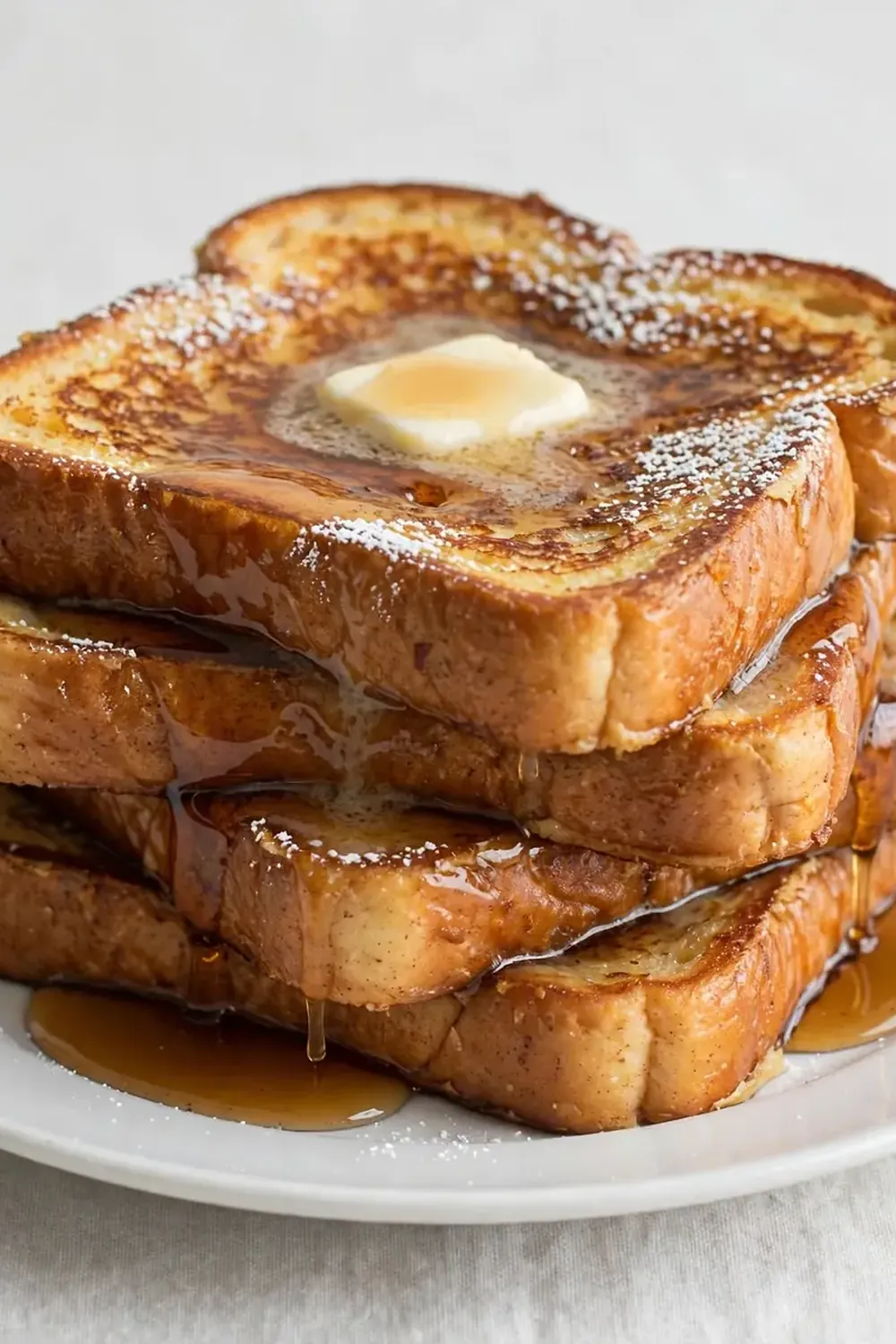
- Flip and finish: Using a spatula, flip the slice over. The cooked side should be a rich amber colour with darker spots where the custard caramelised. Cook for another 2 minutes until the second side is equally golden and the centre feels firm but springy when pressed gently with the spatula.
- Keep warm while you finish: Transfer the cooked French toast to a plate and keep it in a low oven (about 100°C) while you repeat with the remaining slices, adding more butter to the pan as needed. The kitchen should smell warmly of cinnamon and vanilla at this point.
- Serve immediately: Stack two slices per person, drizzle generously with maple syrup, and add a handful of fresh berries if you like. A light dusting of icing sugar makes it look rather special, though that’s entirely optional.
Tips From My Kitchen
- Use stale bread on purpose: Bread that’s a day or two old has a tighter crumb structure that absorbs custard more evenly without disintegrating. Fresh bread turns to mush because its moisture content is too high — the custard can’t penetrate properly, leaving you with a soggy centre.
- Rest the soaked bread for 30 seconds: After dipping each slice, let it rest on the plate for half a minute before hitting the pan. This allows the custard to fully penetrate the bread’s interior rather than just coating the surface. You’ll notice the slice feels heavier and more uniform.
- Medium heat is non-negotiable: Too high and the outside burns before the egg custard sets in the middle. Too low and the bread soaks up excess butter, becoming greasy and heavy. The butter should sizzle steadily when you add the bread but never smoke or turn dark brown.
- Don’t overcrowd the pan: Cook only as many slices as will fit in a single layer with space between them. Overcrowding drops the pan temperature, causing the bread to steam rather than fry, which results in pale, rubbery French toast with a soggy texture.
- Make the custard ahead: Whisk the egg mixture the night before and store it covered in the fridge. Give it a quick stir before using, as the cinnamon and nutmeg will have settled at the bottom. This saves you a solid five minutes on busy mornings.
- Double up for freezing: Cook the full batch, let the slices cool completely on a wire rack, then freeze them in a single layer on a baking tray. Once frozen solid, transfer to a zip-top bag. Reheat straight from frozen in a toaster or under the grill for a 90-second breakfast.
Equipment You’ll Need
- Large frying pan or skillet (non-stick works best for minimal cleanup)
- Sharp knife and cutting board
- Mixing bowl (medium size)
- Whisk or fork
- Wooden spoon or spatula
- Measuring spoons
- Small jug for milk (optional but handy)
Common Mistakes to Avoid
- Overcrowding the pan: When you cram too many slices in at once, the temperature of the pan plummets. Instead of frying, the bread steams in its own moisture, resulting in a pale, spongy texture with no crispness. Stick to two slices at a time in a standard 28cm pan.
- Wrong temperature: Medium heat is your friend here. If you see the butter turning brown or smoking within seconds of adding it to the pan, your heat is too high. Conversely, if the butter isn’t sizzling when the bread hits the pan, bump the heat up slightly and wait a minute before trying again.
- Skipping the rest time: That 30-second rest after dipping isn’t just for show. It allows the custard to migrate from the surface into the bread’s interior, giving you that creamy, set centre rather than a raw egg taste. Skip this step and you’ll end up with unevenly cooked French toast.
- Using ice-cold eggs straight from the fridge: Cold eggs don’t whisk up as well and can make the custard lumpy. Let your eggs sit on the counter for 10 minutes before using, or place them in a bowl of warm water for 2 minutes to take the chill off.
- Forgetting to season the custard: That pinch of salt might seem insignificant, but it balances the sweetness and enhances the vanilla and cinnamon flavours. Without it, your French toast can taste flat and one-dimensional.
Delicious Variations to Try
- Spiced Apple Version: Add ½ teaspoon of apple pie spice to the custard mixture and serve with sautéed apple slices. Core and slice one apple, then cook it in a separate pan with a knob of butter and a teaspoon of brown sugar until soft and golden — about 4 minutes.
- Chocolate Lover’s Twist: Stir 1 tablespoon of cocoa powder into the custard mixture before whisking. The chocolate flavour pairs beautifully with the vanilla and cinnamon. Top with sliced banana and a dollop of Greek yoghurt for a dessert-like breakfast.
- Savoury French Toast: Omit the sugar, vanilla, and cinnamon entirely. Add ½ teaspoon of black pepper and ¼ teaspoon of paprika to the custard instead. Serve with grilled tomatoes, sautéed mushrooms, and a poached egg on top for a hearty dinner option.
- Vegan-Friendly Version: Replace the eggs with 3 tablespoons of cornflour mixed with 6 tablespoons of water (this creates a slurry that mimics egg’s binding properties). Use oat milk instead of dairy milk, and fry in coconut oil rather than butter. The texture will be slightly less rich but still satisfyingly crisp on the outside.
- Stuffed French Toast: Make a sandwich with two slices of bread, spreading a thin layer of cream cheese and raspberry jam between them before dipping the whole sandwich in custard. Cook as usual, flipping carefully — the centre will be warm and gooey.
What to Serve With Classic French Toast
- A handful of fresh berries or sliced banana for a fruity contrast
- A dollop of thick Greek yoghurt or crème fraîche to cut through the sweetness
- A side of scrambled eggs if you’re serving this as a dinner and want extra protein
- A small green salad with a simple lemon vinaigrette — the acidity balances the richness beautifully
- For a heartier meal, pair it with my Chicken Fajita Bowl Recipe Deconstructed Tacos for a sweet-savoury combo that works surprisingly well
Still hungry for ideas? You might also love Griddle Blackstone French Toast, French Toast With Blueberries Brioche from our sister kitchens.
Frequently Asked Questions
Classic French Toast
Ingredients
Method
- Prepare the custard: Crack the eggs into a medium mixing bowl and whisk vigorously for about 30 seconds until the yolks and whites are fully combined and the mixture looks pale yellow and slightly frothy. Add the milk, caster sugar, vanilla extract, cinnamon, nutmeg, and salt, then whisk again until the sugar has dissolved — you should hear the granules scraping against the bottom of the bowl disappear.
- Heat the pan: Place a large frying pan or skillet over a medium heat and add half the butter. Watch as the butter melts, sizzles gently, and begins to foam — that foaming sound tells you the pan is at the right temperature. If the butter browns immediately, the heat is too high.
- Soak the bread: Take one slice of bread and dip it into the custard mixture, holding it for about 10 seconds per side. You want the bread to feel heavy and saturated but not falling apart — when you lift it, a few drips should fall, but the slice should hold its shape. The surface should look uniformly wet with no dry patches.
- Cook the first batch: Carefully lay the soaked bread into the hot butter. You should hear a satisfying sizzle immediately — if you don't, the pan isn't hot enough. Cook for 2 to 3 minutes until the underside is deep golden brown and the edges look caramelised. The surface will start to puff up slightly as the egg cooks.
- Flip and finish: Using a spatula, flip the slice over. The cooked side should be a rich amber colour with darker spots where the custard caramelised. Cook for another 2 minutes until the second side is equally golden and the centre feels firm but springy when pressed gently with the spatula.
- Keep warm while you finish: Transfer the cooked French toast to a plate and keep it in a low oven (about 100°C) while you repeat with the remaining slices, adding more butter to the pan as needed. The kitchen should smell warmly of cinnamon and vanilla at this point.
- Serve immediately: Stack two slices per person, drizzle generously with maple syrup, and add a handful of fresh berries if you like. A light dusting of icing sugar makes it look rather special, though that's entirely optional.
Notes
I hope this Classic French Toast becomes your weeknight saviour the way it’s become mine. It’s one of those rare recipes that feels indulgent yet takes almost no effort, and it’s saved me more times than I can count when dinner plans fell through. If you give it a try, I’d love to hear how it went — drop a comment below and let me know what toppings your family loved best. For another quick dinner idea that’s just as speedy, have a look at my Shrimp Pasta Recipe Simple And Quick Seafood, which comes together in about the same time. Happy cooking!